Park

Park (44)

29 Mai 2019

UNESCO World Heritage List

Written by

Cultural and natural heritage is counted among invaluable and indispensable goods, not just for each country, but for all humanity. Loss of any of these invaluable goods because of deterioration or disappearance means impoverishment of the heritage of all nations of the world. Parts of this heritage, due to their exceptional characteristics, can be considered as goods of "outstanding universal value" and as such, they deserve special protection from the dangers they are increasingly threatened by.

Having been included in the World Heritage List in 2017, the beech forests in the area of Paklenica National Park and the Northern Velebit National Park belong to globally significant localities.

DSCF9719 1

UNESCO is an organization that has been implementing the idea of the need to preserve the world's natural and cultural heritage since 1972, when the Convention Concerning the Protection of the World's Cultural and Natural Heritage was adopted. The purpose of the Convention is to identify, protect, conserve, present and transmit to future generations the cultural and natural heritage of outstanding universal value. One of the most important instruments of the Convention is the inclusion of heritage into the UNESCO World Heritage List. The main basis for inclusion in the Natural Heritage List is that a heritage asset has an outstanding universal value under one of the four criteria:

- areas of exceptional natural beauty and aesthetic importance

- areas representing major stages of Earth's history, significant geological processes and possessing significant geomorphic or physiographic features

- areas representing an example of ecological and biological processes in the evolution

- areas which are most significant natural habitats for in-situ conservation of biological diversity

The beech forests of Paklenica National Park and Northern Velebit National Park were listed on UNESCO World Heritage List on 7 July 2017, and together with the beech forests of Albania, Austria, Belgium, Bulgaria, Italy, Germany, Romania, Slovakia, Slovenia, Spain and Ukraine comprise the whole of "Ancient and Primeval Beech Forests of the Carpathians and Other Regions of Europe". For inclusion in the UNESCO World Heritage List, as Croatian representatives of the primeval beech forests, two sites were selected, one within the boundaries of Paklenica NP (Suva draga-Klimenta and Oglavinovac-Javornik) and the other part within the borders of Northern Velebit NP (Rožanski and Hajdučki kukovi).

DSC 1329 1

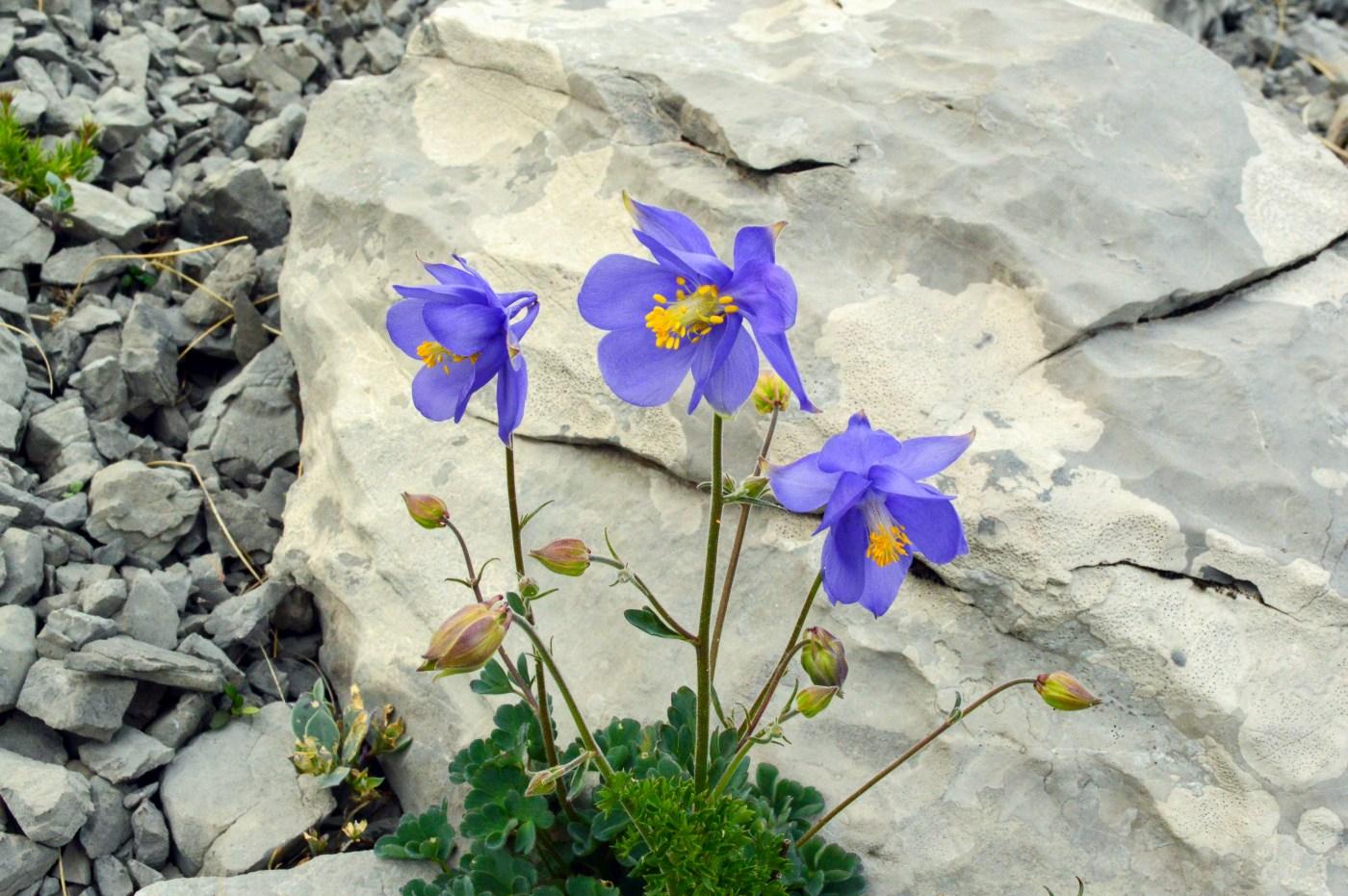
The beech forests of Paklenica and Northern Velebit National Parks represent exceptionally preserved and undisturbed forest ecosystems, whose authenticity and integrity have been secured by years of protection. They are a valuable part of the European primeval beech forests and an important haven for many species, some of which, like the bear, lynx, wolf, stag beetle, longhorn beetle, and holly, peony or forest orchids, are endangered worldwide.

DSC 2510 1

Beech is one of the most important species in deciduous temperate forests. It represents a remarkable example of re-invasion of space and development of forest communities after the last glaciation, across the whole of Europe, under a variety of environmental conditions (climatic and geographic) and over a relatively short period of time. It is a process that continues even today.

With the development of civilization and the cultivation of forest areas, significant forest areas have disappeared all over Europe, including beech forests. Many of the beech forests that are still in existence are used for economic purposes, which harms their authenticity. It is estimated that, before human intervention, ancient beech forests in Europe occupied 91 million hectares. Today, primeval beech forests occupy an area of only 90,000 hectares.  The only examples of primeval beech forests that can still be explored for their intactness and true preservation are limited to relatively small areas, so it was necessary to unify these remains throughout Europe, under one natural good and with one goal, which is joint care.

In 2021, the Unesco World Heritage Series “ Ancient and Primeval Beech Forests of the Carpathians and Other Regions of Europe” was extended with 6 additional States Parties (Bosnia&Herzegovina, Czechia, France, North Macedonia, Poland, and Switzerland). This extension added 15 new protected areas to the network. And more precious forest areas in other countries could follow. The entire World Heritage Site comprises the few remaining European primeval beech forests and centuries-old European beech forest areas, which are almost unaltered by humans.

This World Heritage series is currently the largest serial World Heritage property. With 93 sites in 18 countries, it is the only World Heritage Site globally that connects so many component parts. It covers areas in Albania, Austria, Belgium, Bosnia& Herzegovina, Bulgaria, France, Germany, Italy, Croatia, Czechia, North Macedonia, Poland, Romania, the Slovak Republic, Slovenia, Spain, Switzerland, and the Ukraine. This requires collaboration across boundaries and illustrates the close relationship of the beech forest with European culture.  

Ancient and Primeval Beech Forests of the Carpathians and Other Regions of Europe as a transboundary property is under the joint care of 18 countries in whose territories the individual components are located, and the care is provided through regular meetings and development of joint projects and management documents. More info on the Property is available on the following link: European beech forests 

Specific WH EN bossen Positief


19 Februar 2019

Forsthaus Lugarnica

Written by

DSC 4247

Lugarnica ist ein einfaches Gasthaus, befindet sich unmittelbar neben dem Bach Velika Paklenica neben dem Haupt-Wanderweg. Es ist rund 4 km vom Hauptparkplatz entfernt, aber wenn Sie vom Parkplatz aus direkt zur Lugarnica aufbrechen, gelangen Sie zu dieser in etwa 1.30 h.

In der Lugarnica können Sie mit einem Tee, türkischem Kaffee und einem kalten Getränk Energie tanken oder eine der Speisen aus dem Angebot bestellen. Die Zahlung erfolgt in Bargeld, daher bitten wir Sie, dieses ins Gebirge mitzunehmen.

Arbeitszeit:

Mai - Oktober täglich von 10.00 bis 17.00 Uhr

In der Zeit von Ostern bis Mai ist es nur an Wochenenden und nationalen Feiertagen geöffnet.

Preisliste Lugarnica 2026.

19 Februar 2019

Eingang 2 Mala Paklenica

Written by

Eingang 2 Mala Paklenica:

Die Rezeption an unserem zweiten Eingang in den Nationalpark Paklenica befindet sich vor der Schlucht der Kleinen Paklenica in Seline und ist während der touristischen Saison geöffnet.

Eingang 2:

p>

Eingangskoordinaten: 44.283077, 15.49276 

19 Februar 2019

Eingang 1 Velika Paklenica

Written by

An der Rezeption am Eingang 1 können Sie eintägige oder mehrtägige Eintrittskarten für den Parkbesuch kaufen, sowie nützliche Informationen erhalten. Wenn Sie mit dem Auto zum Park kommen können Sie auch einen Parkschein kaufen.

Eingang 1:


Eingangskoordinaten: 44.294053, 15.457578


DSC 4247

Lugarnica is a simple catering object, located right next to the Velika Paklenica stream beside the main hiking trail. It is 4 km away from the main parking lot, and if you go straight to Lugarnica from there, you should arrive in about 1.30 h.

At Lugarnica you can lift your spirits with tea, Turkish coffee and a cold drink or order some of the dishes on the menu. Payment is made in cash only, so we suggest you bring it along when you leave for the mountain.

Working hours:

May – October daily from 10 am to 5 pm

In the period from Easter till May it is opened only on weekends and on national holidays.

 Price list for food and beverages in Lugarnica Cottage 2026

07 Februar 2019

Entrance 2 Mala Paklenica

Written by

The reception at the second entrance to the Paklenica National Park is located in front of the Mala Paklenica canyon in Seline. It is open only during the main visiting season. 

You can also buy entrance tickets, which are valid for Entrance 1, at Entrance 2.

Entrance 2:

p>


Entrance coordinates: 44.283077, 15.49276

07 Februar 2019

Entrance 1 Velika Paklenica

Written by

You can buy 1-day or several-day tickets for visiting the Park, a parking ticket if you’re entering by car and receive useful information at the Entrance 1 reception.

The Paklenica National Park’s price list is available on the following link: price list

Entrance 1:

Entrance coordinates: 44.294053, 15.457578


UNESCO Man and the Biosphere Programme (MaB Programme)
 
United Nations Educational, Scientific and Cultural Organization (UNESCO) established the Man and the Biosphere Programme in 1970, as an intergovernmental scientific programme that promotes the importance of achieving the balance between conserving biodiversity on one hand and development needs of local communities on the other hand.
Within the Programme, a worldwide network of representative significant ecosystems on Earth was created in 1974. Within, the genetic diversity is conserved as a prerequisite for biological diversity, research of ecological systems is conducted, their condition is monitored and education is provided. Certain areas within this network are called biosphere reserves and these are internationally recognized within the UNESCO Man and the Biosphere Programme as areas that promote solutions for a balanced relationship between protection of biological diversity and its sustainable use through the fulfillment of three basic biosphere functions:
  • Conservation function - they contribute to the preservation of landscapes, ecosystems, species and genetic variability;
  • Development function – they foster economic and human development which is socially, culturally and ecologically sustainable;
  • Logistics function – they provide support for research, monitoring, education and information exchange related to local, national and global issues of conservation and sustainable development.
Velebit Mountain was our first biosphere reserve, proclaimed in 1978, immediately upon establishment of the world network of biosphere reserves. Our second biosphere reserve, Mura-Drava-Danube, was proclaimed in 2012. It is a transboundary reserve, stretching over the territory of Croatia and Hungary.
It should be clear that the term “biosphere reserve” does not imply strict protection of the area. It is a name of the area management concept which includes three zones: core area, buffer zone and transition zone.
Core area must be legally protected; it comprises ecologically most valuable areas and it is intended for scientific research and monitoring (areas within national parks, strict nature reserves and special nature reserves).
Buffer zone surrounds the core area and it has to be clearly identified (area of the Nature Park Velebit). It shelters the core area from potential negative influence and sustains the activities harmonized with conservation objectives (mostly sustainable tourism, agricultural and forest management with applied protection measures).
Transition zone mostly comprises populated areas next to the buffer zone, where educational activities are conducted and sustainable development is promoted as part of economic development.
Zonacija rezervat
 
There are many benefits pertaining to the proclamation of a biosphere reserve. The concept of biosphere reserve can be used as a framework for guiding and strengthening the projects which improve people’s lives and ensure environmental sustainability. UNESCO’s recognition can emphasize and award such individual efforts. Designation of a biosphere reserve can raise the awareness of the local population and the authorities on environmental protection within sustainable development. It can help attract additional resources from different sources. On the national level, a biosphere reserve can serve as a pilot area or “learning point” for research and demonstration of an approach to conservation and sustainable development, as well as their application in other areas.
 
The MAB Programme was among the first in the world which put an emphasis on achieving the balance between conserving biodiversity on one hand and development needs of local communities on the other, which is why it was supported by the World Park Congress and today it greatly contributes to the application of the Convention on Biological Diversity and UN Millennium Development Goals.
 
 sector sc mab new en


BROCHURE

MAP

07 Februar 2019

Local religious customs

Written by
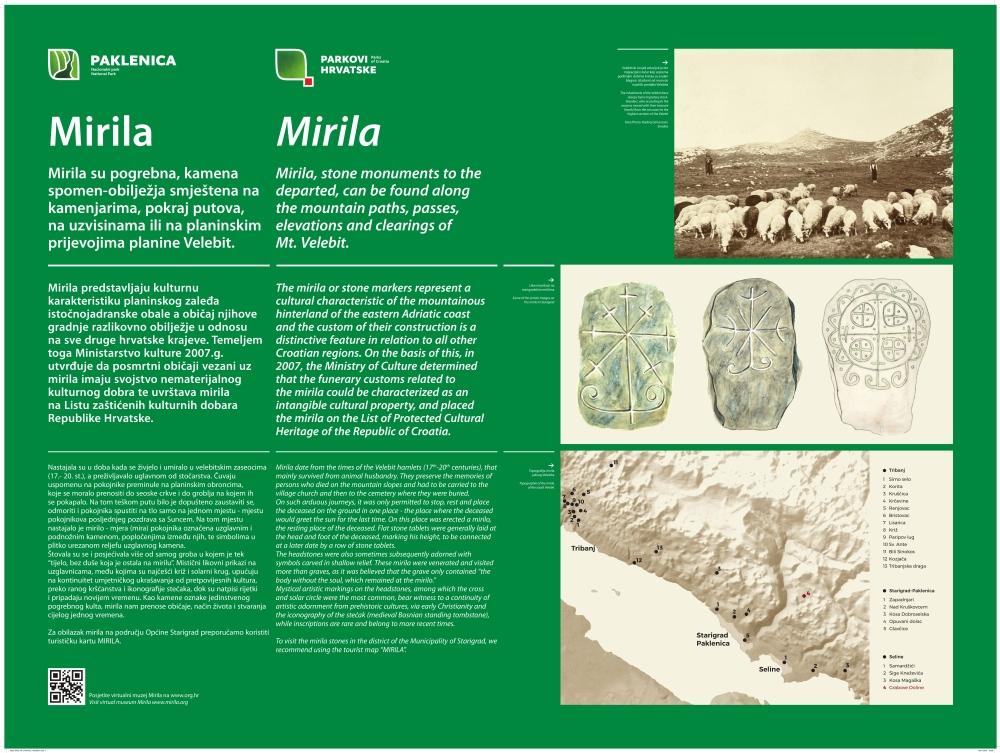
Mirila (Measures) are unique landmarks alongside the paths and trails of the Velebit Mountain. They were made in the period between the 17th and the 20th century, and are associated with a sepulchral custom of the local population who had to carry their dead to the cemetery because the church and the cemetery were far away. They consist of a headstone and a footstone, with paving between them. The length of the deceased was measured and marked with two stone tablets, so the measure was made after the deceased was buried. They were worshipped and visited more than the grave, where “only the body lies, without the soul that remained at the measure”.
 

Mirila, stone monuments to the departed, can be found along the mountain paths, passes, elevations and clearings of the Velebit Mountain. They preserve the memories of persons who died on the mountain slopes and had to be carried to the village church and then to the cemetery where they were buried. Today, Mirila are protected as the Intangible Cultural Heritage of the Republic of Croatia.

Visit exhibition "Mirila-resting places of the souls"  in ethno house Marasović in Starigrad-Paklenica. This is the exhibition about the stone markers of a unique funeral cult, which convey the customs, way of life and creativity of an entire era, in a contemporary interpretation of scientist and artist (Siniša ReberskiKrešimir RončevićRadivoj SimonovićTomo VinšćakMirjana TrošeljPetar i Josip StrmečkiJosip Zanki).


mirila


Site Grabove doline

There is preserved location with Mirila on the locality Grabove doline inside the Paklenica NP. These monuments are connected to the nearby settlement. 

Poučna staza Mirila

PLOČA TIP 8Tabla Mirila NP Paklenica 120x90cm 1

For more information, you can visit the Mirila Virtual Museum


07 Februar 2019

Traditional architecture

Written by

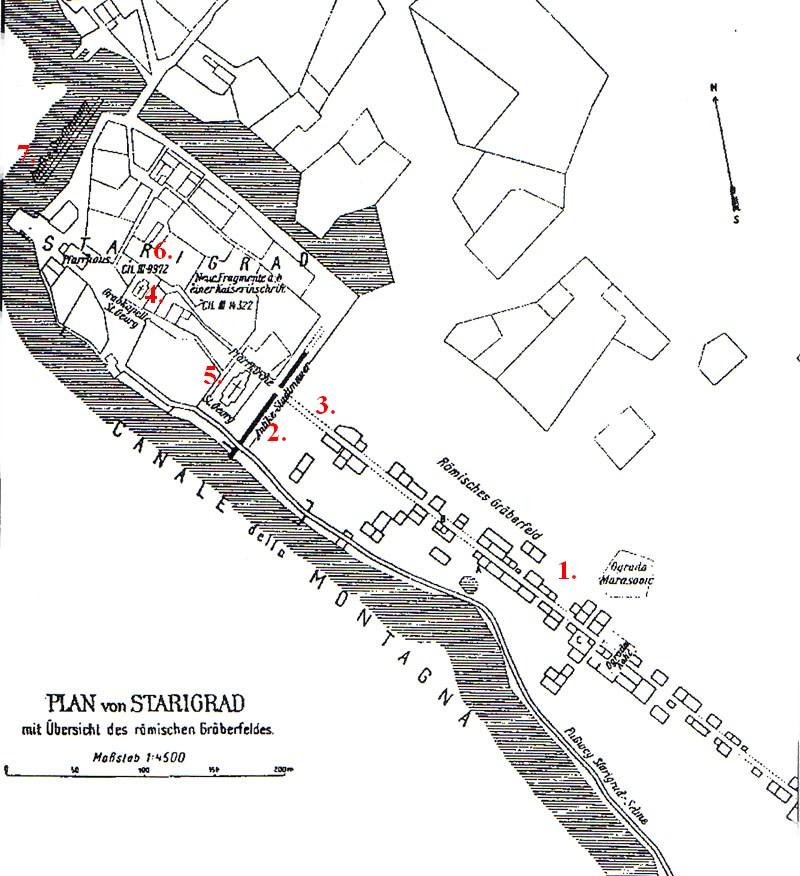
The arrival of Croats in this area began in the early Middle Age. The earliest preserved traces of their presence are the chapels of St. George (Sv. Juraj) in Rovanjska and the chapel of St. Peter (Sv. Petar) in Starigrad, built in the 9th or 10th century A.D. 

Chapel of St. Peter (Sv. Petar) in Starigrad

Two forts - Večka kula (on the cape just east of Starigrad) and Paklarić (on top of a long-abandoned prehistoric hillfort, overlooking the entrance to Velika Paklenica gorge) – were probably erected in the late Middle Age (14th-16th century).

Vecka kulaThe depiction of the ruins of Večka Tower during the Turkish wars (by Martin Stier, mid-17th century)

This era was followed by two centuries of war with the Turks. The population fled and the area at the foot of Velebit was completely abandoned. As the Turkish power began to fade, in 1671 the Venetian authorities began to populate the area of Starigrad with Bunjevacs, a Croatian population from the neighboring areas that were still under Turkish occupation. In 1700, the Turks finally retreated, and the area at the foot of South Velebit was annexed to Venetian Dalmatia.

People
The pastures and treatable land of Velebit, contained in karstic sinkholes, provided for the local population. Having adapted to the geographic and climatic environment, the residents mostly engaged in nomad stock herding, which is confirmed by mountain shepherd residences. The fact that many people stayed in mountain residences in the summertime is reflected in the ruins of numerous sacral buildings: churches, chapels, altars, holy hills and measures (mirila). The features of the area are also reflected in the traditional architectural style – namely, the cube roofs, concrete barrel-shaped roofs that have remained preserved on houses, economic facilities and mills along the stream of Velika Paklenica.

Distinctive roof architecture

There are ten old settlements inside the National Park, which are now mostly abandoned:  Parići, Ramići, Kneževići, Katići, Škiljići, Jasenar, Rimenić, Jurline, Marasovići and Njive. Particularly interesting is the site Sklopina with the houses built into semi-faults.

Sklopina

Seite 1 von 4
Image

Javna ustanova Nacionalni park Paklenica
Dr. Franje Tuđmana 14a
HR - 23244 Starigrad-Paklenica

Tel.: +385 (0) 23 369 155, 369 202 (Verwaltung)

       +385 (0) 23 369 452 (Camp "Nacionalni park")
       +385 (0) 23 369 803 (Eingang 1 Velika Paklenica)


E-mail:
np-paklenica@paklenica.hr
prezentacija@paklenica.hr (info)

OIB: 24913665146
IBAN: HR0824070001100579272, OTP banka

Image

IZJAVA O ZAŠTITI PRIVATNOSTI I SIGURNOSTI OSOBNIH PODATAKA